Orbital Mechanics · Launch Vehicles · Interplanetary Transfers · Hypersonic Entry
This section presents advanced university coursework and technical reports focused on spaceflight engineering, orbital mechanics, and atmospheric entry. The work was completed as part of the AERO4800 sequence at The University of Queensland and involves the development of physics-based numerical solvers implemented in Python.
Developed and validated a three-degree-of-freedom Mars atmospheric entry solver to simulate hypersonic aerocapture trajectories. The model incorporates lift and drag, an exponential Martian atmosphere, altitude-dependent gravity, and coupled equations of motion.
Aerothermal analysis was performed using convective and radiative heating correlations to predict stagnation-point heat flux and temperature histories. A parametric study was conducted to identify optimal entry conditions balancing thermal load, controllability, and propulsive correction requirements.
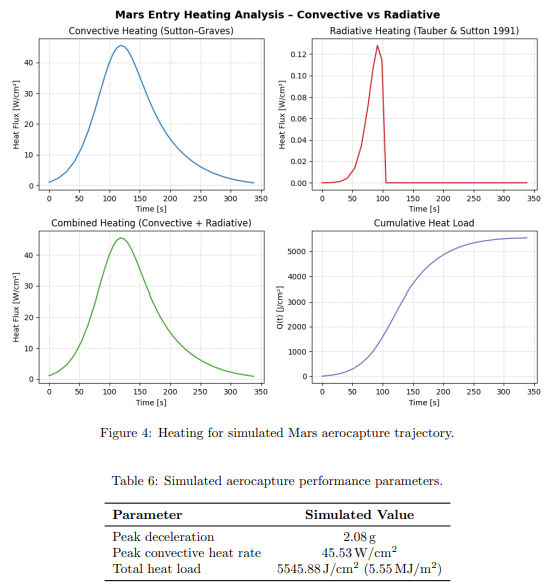
Integrates orbital mechanics, hypersonic aerothermodynamics, numerical ODE solvers, and validation against published NASA aerocapture studies.
View Flagship Report (PDF)
View Full Code Repository (GitHub)
Implemented an interplanetary trajectory modelling framework to analyse Earth–to–Mars transfers using Lambert solutions and planetary ephemerides. The study compared conventional propulsive Mars orbit insertion with atmospheric aerocapture as a mission optimisation strategy.
View Report (PDF)Developed a three-degree-of-freedom numerical solver to model the ascent of a multi-stage launch vehicle from liftoff to orbital insertion.
View Report (PDF)